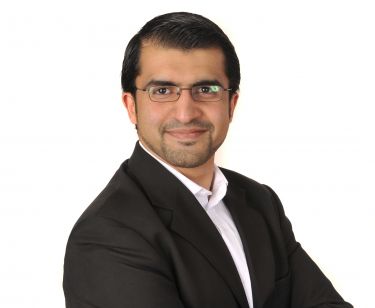
In this interview, we sit down with Dr Hossein Sharif, Programme Director of our Project Management, Finance and Risk MSc.
Academic interests and expertise
Can you tell us about your academic and research background?
I studied Electronic Engineering as an undergraduate and followed it with a PhD in Artificial Intelligence. Throughout, I kept one foot in industry—helping banks analyse their Big Data, prototyping AI credit-scoring engines and later founding one technology start-up, consultancy firm and a research centre.
Today my projects apply AI and machine learning to credit scoring, personal-finance management, peer-to-peer lending and supply-chain provenance while exploring how digital-transformation strategies unlock innovation. This constant dialogue between lab and boardroom feeds directly into my teaching and research.
How do you see your field evolving over the next decade?
Over the next decade AI will shift from back-office optimiser to front-office decision-maker. Explainable models will offer real-time credit for previously “thin-file” borrowers, while tokenised assets and smart-contract platforms decentralise project finance. In parallel, generative-AI copilots will handle routine scheduling, freeing managers to focus on strategy and ethics. Professionals who can integrate algorithmic insight with rigorous risk governance will therefore be in highest demand.
Why this course?
What makes this postgraduate programme unique within its field?
Very few UK degrees fuse project management, finance and quantitative risk into one curriculum. Ours does, via core blocks such as Management of Projects, Risk Analysis and Management and Financial Engineering & Planning, plus electives ranging from Digital Innovation and Leadership, Game Theory, Network Science & Decentralised Finance, Data Visualisation to Supply-Chain Management. Classes are co-taught by engineering faculty, Bayes Business School colleagues and industry executives, so concepts are anchored in live cases like Eurotunnel-scale megaprojects or FinTech platform roll-outs.
What support is offered to help students transition from undergraduate to postgraduate study?
Preparation begins with an online Introductory Mathematics refresher and Python primer. Furthermore, our lecturers use customised content to fit the specific needs and requirements of the range of students undertaking this programme.
Are there opportunities for networking with alumni or industry professionals during the course?
We have regular industry expert seminars as well as alumni events enabling our students to learn new concepts and ideas while growing their professional network nationally and internationally. Moreover, MSc students can undertake their 60-credit dissertation with partners ranging from major advisory firms, manufacturing companies and technology start-ups to FinTech companies. These collaborations have a significant potential to convert into internship or full-time offers.
Career paths
How does the programme help students develop skills for their future careers, whether in academia or industry?
Every element of the MSc is deliberately skills-centred: core modules such as Risk Analysis and Management and Optimisation & Decision Making embed quantitative techniques for modelling uncertainty, while Mathematics Foundations with Python ensures you can implement those models in code.
The assessments range from technical reports to presentations, sharpening both analysis and communication. There is also an optional summer PRINCE2® certification which adds an externally recognised project-management credential. Finally, the 60-credit dissertation lets you apply the full toolkit—analytical, managerial and ethical—to a substantial real-world problem, providing a bridge to either doctoral study or professional practice
What career paths have graduates from this programme typically followed?
Because the degree integrates project-management method, financial planning and risk analytics, graduates can move into a wide spectrum of roles. They can join infrastructure or capital-goods organisations where life-cycle costing and risk governance are critical. Others can enter management-consultancy practices, quantitative-risk teams in banking and investment, or specialist functions such as supply-chain strategy and financial-risk analysis for pharmaceuticals or real estate.
Tips for offer holders
If you could highlight one thing that students should look forward to in this programme, what would it be?
Look forward to the 60-credit dissertation, because it is far more than a research paper. After completing the taught blocks you pitch a project—potentially co-designed with an external organisation—and spend the summer applying the programme’s toolkit to a real strategic question.
Whether you build a stochastic cash-flow model for a renewable-energy fund or assess blockchain risk in a supply-chain start-up, you will finish with a portfolio piece that demonstrates academic depth and immediate business value. Some students convert this collaboration into a job offer, making the dissertation the programme’s launch-pad.
What advice would you offer to offer holders as they prepare to join this course?
Brush up on calculus, linear algebra and probability: every risk model rests on them. Work through a short Python refresher (NumPy, Pandas) and skim a PRINCE2® or PMI® guide—project-management vocabulary speeds your first term. Arriving numerate, code-ready and method-aware will let you seize the opportunity better and focus on higher-order thinking from day one.