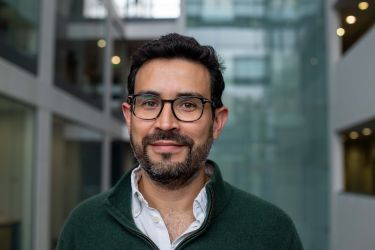
In this interview, we sit down with Alejandro Riaño, Programme Director for our Economics MSc programmes.
Academic interests and expertise
Can you tell us about your academic and research background?
I earned my PhD in Economics from Penn State University in 2009 and before that I worked at the Inter-American Development Bank in Washington DC.
I'm really interested in how both firms and people respond to globalisation—especially when it comes to trade liberalisation and export promotion. I've looked at the effects of export subsidies and place-based policies (like special economic zones) in countries like China, Mexico, Nepal, the Dominican Republic, and Pakistan. I also study how firms decide whether to export or import, and how opening up to trade affects things like wages, informality in the labour market, and even child mortality.
What inspired you to specialise in your current field of study?
I first got interested in international trade when I was around 10. I remember suddenly seeing American sweets like M&Ms and Snickers bars pop up at my local corner shop—these were a big deal back then! You’d usually only get them if someone brought them back from a trip abroad. Then came the cool Nike trainers that Andre Agassi wore—also suddenly available. It was all thanks to the Apertura, Colombia’s big trade liberalisation push, which the government was heavily promoting at the time. So, in a way, I got an early taste of the ‘welfare gains’ from trade. But not long after, I started seeing the other side too—like how unemployment shot up in my hometown when cheap rice, coffee and other imported agricultural products started flooding in, undercutting local producers. Since then, I’ve been fascinated by trade. It’s something humans have done since the beginning of time, which can bring incredible benefits through the exchange of goods, ideas, and services—but it can also be hugely disruptive.
What do you enjoy most about teaching and mentoring students?
I get a lot of satisfaction from watching students grow intellectually—especially when they make that shift from being ‘consumers’ of economic research to becoming ‘producers’. That switch is more than just a mindset change—it means learning how to ask good questions about human behaviour and figuring out which economic tools, models, and econometric techniques to use to actually answer them. Our postgrad students come from all sorts of backgrounds, which makes class discussions really engaging. Quite a few have worked at firms trying to break into international markets, and their real-world experience often gives me new angles to think about in my own research.
Why this course?
What makes this postgraduate programme unique within its field?
The MSc Economics suite at City strikes a great balance between solid theoretical training and real-world, applications to businesses, professions and policymaking. We’ve got a strong, self-contained core in micro, macro, and quantitative methods, while at the same time students can tailor their studies with a wide range of optional modules including data analytics, strategy, corporate finance, economic policy, economic evaluation, and many more. There’s a lot of flexibility to shape the course around the career path you're aiming for.
We also offer three different routes for the research part of the degree: a traditional academic dissertation, a more structured literature survey, or a company project—where students team up with an external organisation (like a firm, consultancy, or local authority) and apply the tools they’ve learned to tackle real-world questions that matter to that organisation.
And of course, being based in Clerkenwell means students are right in the heart of London, with access to policymakers, financial institutions, and an amazing professional network—not to mention everything else the city has to offer. Honestly, it’s hard to think of a better place to be a student.
What support is offered to help students transition from undergraduate to postgraduate study?
To ease the transition, we begin with a pre-sessional activities covering essential mathematics and statistics. Students benefit from small group teaching, regular office hours, and one-to-one academic support. Practically-oriented modules introducing students to programming in Stata and Python, research methods, and dissertation planning further build student confidence.
Career paths
How does the programme help students develop skills for their future careers, whether in academia or industry?
Our programme equips students with strong analytical and quantitative skills valued in both academia and industry. Through coursework and empirical projects, students gain proficiency in tools like Stata, and Python. They learn to frame economic questions, interpret empirical results, and communicate findings effectively—skills vital for careers in research, consultancy, finance, or government.
What career paths have graduates from this programme typically followed?
Graduates pursue diverse careers in the private sector in insurance, multinational companies, finance, consulting, government and some continue their journey towards an academic career pursuing PhD programmes in the UK and abroad.
Tips for offer holders
If you could highlight one thing that students should look forward to in this programme, what would it be?
One of the best—and most unique—things about our programmes is the flexibility they offer. You can choose from a wide range of modules and really shape your own path, creating a study experience that’s tailored to your goals and interests. It’s all about giving you the tools to get the most out of the programme and set yourself up for success afterwards. We also put a strong emphasis on practical work—learning the techniques and tools you’ll actually use in the real world, not just in theory.
What advice would you give offer holders as they prepare to join this course?
Approach the programme with curiosity and a willingness to engage critically with economic ideas. Refreshing your knowledge of basic maths and statistics before the course begins is beneficial. Be open to exploring new fields—you might discover a passion for topics you hadn't considered before. Don't hesitate to reach out to academic staff; we're here to support you throughout your journey.