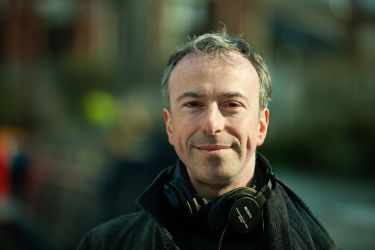
In this interview, we sit down with Dr Aaron Einbond, Reader in Music of our Music by Research MA.
Academic interests and expertise
Can you tell us about your academic and research background?
I am a composer and researcher whose work connects instrumental music, field recording, sound installation, and interactive technology to explore relationships between instrument, loudspeaker, listener, space, and place. My research addresses the pressing issues of artificial intelligence (AI) and three-dimensional (3D) sound to situate the listener at the centre of an immersive experience.
What inspired you to specialise in your current field of study?
I began my studies with an undergraduate degree in Physics and Music in the United States where “double majors” are possible. I then came to the UK as a Marhsall Scholar where I discovered the amazing music scene in London. Looking for a career combining my interests, interactive music technology offered the perfect combination. I am proud to direct the MA Music by Research, which also offers students the possibility to define a distinctive research area that may not fit neatly into existing fields.
What do you enjoy most about teaching and mentoring students?
Teaching and mentoring students, especially the engaged research students of the MA programme, is like participating in a stimulating research collaboration: in the process of advising students on their research ideas, I must reconsider and refine my own ideas. This can lead to new threads that I then pursue in my own research. In the meanwhile, I hope I can support students to follow their ideas in directions I never would have thought of myself!
Why this course?
What makes this postgraduate programme unique within its field?
Our course is as broad as the diverse, fluid, genre-bending, cutting-edge musical personalities of our students. Rather than asking students to choose between composition, sound art, performance, or musicology, we encourage our students to explore the borders between subfields and forge their own unique path. We do this by placing our focus on students’ individual research projects under the one-to-one supervision of an expert mentor.
What support is offered to help students transition from undergraduate to postgraduate study?
The field of music research is new to many of our students coming out of undergraduate studies or professional music backgrounds. We support this transition with intensive workshops on music research topics, especially in practice research, where City St George’s is a leader in the field. Practice research asks students to consider how their musical creativity can convey knowledge just as rigorously as a research paper, and together we explore methodologies to share this creative work in a compelling and rigorous way.
Are there opportunities for students to tailor the programme based on their specific academic or career interests?
Tailoring the programme to students’ academic or career interests is our primary goal! We offer a small amount of intensive lecture content so the rest of our students’ time is free to focus on their MA Major Project. Students define their own topic with the guidance of an expert supervisor and pursue their self-guided research. We are looking for students with strong initiative and personal goals and we support them to bring those goals to fruition.
Career paths
How does the programme help students develop skills for their future careers, whether in academia or industry?
By encouraging self-guided research and personal initiative, the programme helps develop bold, courageous, independent thinkers for future careers in academic or professional music. Today’s music scene does not offer pre-cut careers on a silver platter: instead, musicians need to forge their own way and define their own paths. That is what the MA Music by Research programme is all about!
What career paths have graduates from this programme typically followed?
Many of our graduates have gone on to pursue doctoral study at City St George’s or other institutions, often winning competitive funding opportunities for doctoral studentships. Graduates have also gone on to careers in the music industry as producers, composers, and performers. In all cases, the MA Major Project is an ideal portfolio or calling card to show off our graduates’ distinctive musical identities to future supervisors and employers.
Tips for offer holders
If you could highlight one thing that students should look forward to in this programme, what would it be?
In addition to one-to-one supervision on a self-defined music research project, students can look forward to a roster of world-leading guest lecturers who introduce the state-of-the-art across a broad range of musical disciplines. These are accompanied by opportunities to participate in the musical and research life of the Department of Performing Arts, including performance ensembles, concerts, our research centre SPARC (Sound Practice and Research at City St George’s), our SPARC Lab facilities for immersive sound and movement, and our industry-standard sound studios and practice spaces.
What advice would you give offer holders as they prepare to join this course?
A strong application is focused on presenting your musical identity and vision for your MA Major Project, so please include a sample portfolio of music and/or writing showing the work of which you are the proudest. Please also include a personal statement and topic proposal in which you tell the story of your musical journey and where you would like to take it in the future!