

Welcome to the School of Health & Medical Sciences
The School of Health & Medical Sciences (SHMS) is a leading provider of healthcare education and applied healthcare research, offering outstanding teaching and clinical facilities in the heart of London.
You’re joining us at a very exciting time, as we begin our first academic year as one of the largest higher education destinations for London students and a vital supplier of healthcare professionals in the UK - and all the new opportunities this brings with it.
We can't wait to welcome you!
Making the most of your first few weeks
“Welcome to City St George’s! We’re delighted to have you join our community of future healthcare and medical professionals.
The first few weeks can feel both exciting and overwhelming, but they’re also a vital time to lay the foundations for your success. Start by attending your induction sessions and getting to know your programme teams, Academic Advisers (formerly known as Personal Tutors), and fellow students — strong connections make a real difference.
Explore the wealth of support available to you early on: from the Academic Learning Support and Library Services to our Wellbeing and Careers teams. Don’t wait until you need help — know where to go and who to ask. Visit the Academic Resources site for workshops on academic writing, tips on time management, and digital tools. Get familiar with Canvas or Moodle and other platforms which will be central to your learning.
Make it a priority to attend your lectures, skills sessions, labs, workshops and small group activities regularly — this is where knowledge, skills, and confidence begin to build. Engage actively, ask questions, and make the most of office hours.
Finally, look out for School and University welcome events — a great way to meet others, settle in, and start feeling at home.
You’re joining a school with a proud tradition of excellence in health and medical education. Make the most of every opportunity — we’re here to support you every step of the way.”

Dr Robert Nagaj, Associate Dean Education
Registration and StudentHub


Things to know before your start
Disclosure and Barring Service (DBS)
Clerkenwell students will receive a link from our partner company Atlantic Data to complete your DBS check. DBS checks can sometimes take several months so please submit your application as soon as possible once you have received an invite to avoid delays to your placement. Further information regarding the process and the documents you will require can be found on our website.
If you’re due to start at Tooting campus, you will not receive this link.
Occupational Health (OH)
All Clerkenwell students are required to complete an Online Health Questionnaire Health Questionnaire and there may also be a requirement to attend an OH clinic for vaccinations. Further information regarding the process can be found on our website.
If you're a Tooting student, you will have already completed this during your enrolment process.
Uniforms for clinical placement
All Clerkenwell students attending clinical placement will be required to wear specific uniform. Once you are fully registered on your course you will be sent a link by our uniform supplier, Simon Jersey, to place your order. Please place your uniform order as soon as you receive an invite to do so to avoid delays to the start of your placement. For further information regarding our uniform policy and the process for ordering your uniform, please visit our website.
Welcome events within your School
There are lots of great events at the University to welcome you and help you get started in your first weeks.
Comprising of welcome talks, induction sessions, campus tours and more; all designed to help bring together you, staff and fellow students within the School.
One of our main welcome events is the Mini Mixer Event. Come along to socialise with other students, relax, and get a feel for university life before starting your studies.
When: Tuesday 29 September 2026, 5pm to 7pm.
Where: Northampton Suite A, B & C. University Building, Northampton Square.
Light refreshments and snacks will be provided. If you are interested in attending, please register.
To discover other events during your Welcome week, please visit your induction timetable. Don't forget to also check out our Welcome events page to explore what's taking place across the whole University.
In Our DNA
Introducing 'In Our DNA', a new campaign celebrating the people, work and achievements of the School of Health & Medical Sciences.
Through a series of films and stories, the campaign showcases the expertise, innovation and impact across our School, highlighting the difference our staff, students and alumni are making through education, research and practice.
-
Support from SHMS
There’s loads of support available to help you through your time as a student with SHMS. If you are unsure, confused or worried about something which is affecting you on your course, please let us know – we would like to help!
If you are not sure what to do, or need some help to approach the right person, your Academic Adviser or Student Welfare Officer is a great place to start. You can also submit a query through Support@City.
-
Personal Tutor - Your Personal Tutor is your first port of call for any academic or personal concerns. You will have regular scheduled opportunities to meet with your Personal Tutor, in a group and one-to-one. You can also book a 1:1 slot during their Feedback and Support hours.
Course Officer - Your Course Officer can help with any questions about how the course operates, for example: timetabling, access to course materials, assessments and exams. Your Course Officer’s name and contact details will be in your Programme Handbook.
-
Student Welfare Officer - Your Student Welfare Team help you with any non-academic issues which might be affecting your wellbeing, attendance or performance on the course. This may include concerns about your health/mental health, family, relationships, caring responsibilities, accommodation, finance, bullying/harassment, bereavement, managing your workload - or anything which is making you feel stressed, distressed or overwhelmed.
SHMS Learning Support - If you have a disability, neurodiversity, long-term health condition or diagnosed mental health condition, the University's Student Health and Wellbeing service can support you and recommend adjustments to help you access your studies.


Attendance at SHMS
Download the SEAtS App
As student at the School of Health and Medical Sciences: you are expected to attend all of your scheduled classes and record your attendance.
Undergraduates at our Clerkenwell campus are required to download the SEAtS app to check in to classes. Find out how to use SEAtS here.
Why showing up matters
Hear from students about why showing up matters to them:
- “I show up because I’m training to save lives."
- “I know I need to do well to achieve my dream job.”
- “Every class is like adding another puzzle piece to the bigger picture of my understanding of the topics.”
Showing up regularly supports your academic progress, helps you feel part of the community and builds the skills you'll need for your future career. We know that students who attend consistently are more likely to achieve better results.
The Student Charter sets the expectation that you actively engage with your learning connect with peers and tutors, and reach out early if you need support. Find out more about attendance and engagement and where to get support.
Advice from SHMS students - Clerkenwell Campus
Take a look at some advice and testimonials from wide-range of current and ex-SHMS students.
BSc Speech and Language Therapy - Rithvik Tanniru
“What is your favourite thing about studying at City St George's?
The student life at City St George's is also really engaging. There are plenty of opportunities to get involved in the university and meet others. Some of the societies I’ve really enjoyed are the debate and drama societies.
Plus, there are regular events that are run at CityBar.”
BSc Nursing - Marwan Alluhaibi
“What has been your favourite thing about studying Adult Nursing?
One of my favourite aspects of studying nursing is the combination of academic learning and practical experience. The theoretical components have helped me understand the science behind patient care, including anatomy, physiology, pharmacology, and disease management. At the same time, clinical placements have allowed me to apply this knowledge in real healthcare settings, making the learning process more dynamic and engaging.
I also appreciate the personal growth that comes with the course. Nursing challenges you to develop resilience, problem-solving skills, and the ability to adapt to different situations. The sense of accomplishment that comes from successfully managing a patient’s care or supporting someone through a difficult moment is incredibly rewarding.
Another aspect I love is the sense of community among students. Nursing is a challenging course, but having a strong peer network makes a big difference. We support each other through coursework, share experiences from placements, and learn from one another’s perspectives.”
BSc Midwifery - Sally Davies
“Why did you choose to study at City St George's?
I chose to study at City St George's as it has excellent, well-respected teaching staff who contribute widely to research. I felt completely welcome and at ease on Open Days and at my interview. The lecturers largely have clinical experience as midwives, but also as scholars, so they are extremely understanding and supportive.
The course also offers an interesting and varied selection of modules and I feel that I build on my knowledge after each module, and then apply my learning to practice in a structured way. The examination process also combines essays, practical work, and exams, which I have felt well prepared for.
The placement hospitals affiliated with the university mean that students will gain excellent clinical experience and they’ll be ready for anything that their midwifery careers throw at them.”
BSc Radiography - Anshar Griffith
“What would be your advice to anyone considering studying this course?
My advice would be to have a passion about radiography and/or healthcare because this is an intense course and for you to be able to enjoy it and make the most of out of it you need to engage otherwise you will not get a good experience.
Also, I would say not to limit yourself to working in a hospital. Radiography is very dynamic profession, and you can go into so many routes such as being a radiographer for the Royal Navy and travelling around the world, or you could become a forensic radiographer. The sky is the limit in radiography.”
MSc Optometry - Bhiraamy Raj
“What has been your favourite thing about studying this course?
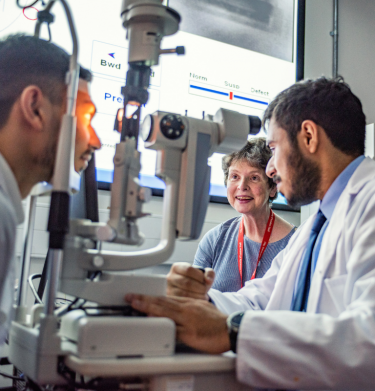
The clinical placements have been my favourite part of the course so far. Getting hands on experience with real patients, especially starting in first year, has been very rewarding and has allowed me to apply what I’ve learned in lectures to real world scenarios.
Coming into this course without an optometry background, these placements have really helped build my confidence and help prepare the skills I’ll need as a future optometrist!”
MSc Adult and Mental Health Nursing - Hannah Stubberfield
“What has been your favourite module or aspect of your course so far?
I love how knowledgeable the lectures are and how skilled they are in their fields. With many of them conducting their own research. I have really enjoyed my time in the Clinical Skills Suites practicing skills in a safe environment before implementing them on real people in placement. I have really enjoyed using the patient simulation suites to learn more about what it is like to live life with a particular condition.”
MSc Health Management - Arham Pirzada
“What has been your favourite thing about studying this course?
Sometimes you find that what you are studying in the classroom never really translates into your work place. So, what I really like about this course is that there is always a parallel to the actual world outside.
We are taught based on real-life scenarios and case studies, so you are always learning practical implications. Moreover, through the year you will also come across opportunities for internships, mentoring and networking with alumni which will help you transition into your role as a professional.”
MSc Speech and Language Therapy - Kirsty Harris
“How has City helped you get to where you are today?
I’m happy I chose to do a master’s at City as it’s set me up for an amazing career that I’m only just beginning. I’m really excited to see what the future hold for me as a Speech and Language Therapist. My time at City has really shaped my career, in terms of my confidence and the network I’ve been able to create from my time at the University.
I wasn’t very sure what I wanted to do before I started my master’s, and I’ve now been able to build a strong career that I love and believe I’ll stay in for decades.”
Advice from SHMS alumni - Tooting Campus
Dr Yogeesh Kamat - Post-graduate doctoral research degree (MD-Res) alumnus
“Not only is a place like London great for meeting people from different backgrounds, but my degree allowed me to meet and interact with people from different educational disciplines. For the first time I was sitting in a class of 100 people, where I might be just one of two or three doctors.
In this respect, St George's was very good at helping you develop your communication skills, because this sort of learning environment makes you think carefully about whether you are communicating things clearly to someone who does not work in the same field as you.”
Wajid Akhter - MBBS alumnus
“St George’s really gives you a unique set of skills to be able to be a leader in any field that you want to go into. So many places you apply to after graduating will choose you because they know healthcare students have a unique skillset you don’t find in many other degrees.
As healthcare students, you have to learn and process vast amounts of information and be very analytical and scientific, but you also develop soft skills, such as good communication skills to be able to speak to very different patients with unique circumstances, as well as the ability to prioritise when there is a lot going on.
You can transfer these skills to so many other fields and already have that understanding of how to be professional, analytical, and empathetic all at the same time. I found that whatever team I am working in, if there is a healthcare professional there who knows the powers that they have and how to use them, they are unbeatable!”
Ricky Lawless - Diagnostic Radiography alumnus
“Diagnostic radiography is not a sprint. Rushing an x-ray or scan for your patient is not going to benefit anyone because it could lead to a mistake. So, take your time and do it properly first time.
That includes exams and assessments. It is also a continuously growing profession with technological advancements happening all the time. Immerse yourself in it by going to study days, attending conferences, and reading the society articles and journals. If you do this, you will always be on top of your career pathway and progression.”
SHMS Social Media Accounts
You can connect with us on our SHMS specific social media channels to keep up-to-date with all the latest news and info regarding our school, and City St George’s, University of London:
Societies overview
There are many university-wide clubs and societies, whether you want to join a sports team or become a member of a club based on your academic interests, cultural connections, faith or political views. There are lots of other options too; from anime to film, running to robotics.
Joining a society is the best way to meet new people with similar interests, to widen your networks and to get exposure to legal professionals. We look forward to seeing what you decide to join. Visit the Students' Union Societies page.